
Do you notice your hair getting thinner, your part widening, or your scalp showing through? Then you're probably looking for something that naturally supports your hair without a major procedure. Polynucleotides for the scalp can play a role in this. On this page, you'll read calmly and honestly what polynucleotides can and can't do for your hair, who they're suitable for, and how a treatment at Dr T. goes. No empty promises, just clear explanations so you know if this is right for you.
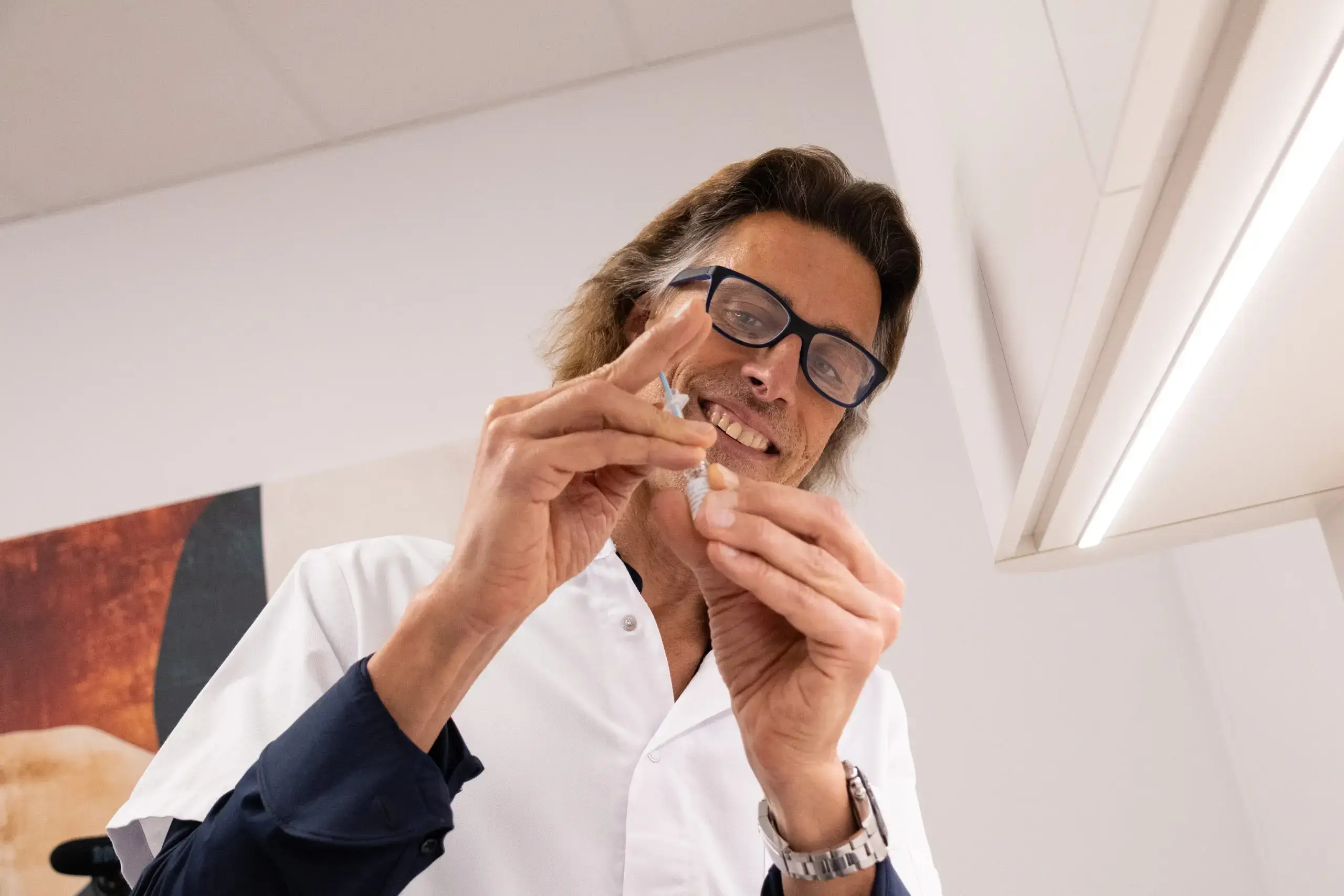
Polynucleotides are small building blocks derived from natural DNA fragments. They are injected in very small amounts into the scalp, at the level where your hair follicles are. The goal is not to "make hair grow out of nothing," but to make the environment around the hair follicle healthier and better supplied with blood.
Thanks to this improved scalp condition, existing hair follicles can function better. The idea is that hair that is now weakened or thinning gets more support and can come back stronger. So it's mainly a supportive treatment for your own hair, not a hair transplant and not a replacement for lost hair follicles.
Important to be honest: where hair follicles have already completely disappeared, polynucleotides cannot create new hair. They work with what's still there. That's why Dr T. carefully examines the condition of your scalp during a consultation before recommending anything.
This treatment is particularly suitable for people who notice their hair gradually thinning or looking less full, while there is still some hair growth present. Think of a wider part, finer hair, or a scalp that shows through more than before. This can be a suitable step for both men and women.
Polynucleotides are less useful or not useful when there is advanced, permanent baldness with lost hair follicles. In that case, it's fairer to point that out rather than starting a treatment that will deliver little. Sometimes a referral or a different approach makes more sense.
Also with active infections or skin conditions on the scalp, or with certain medical conditions, the treatment is advised against or postponed. During pregnancy or breastfeeding, we never treat. During your consultation, discuss your health and medications honestly so Dr T. can assess whether this is safe and sensible for you.
Everything starts with a consultation. Dr T. examines your scalp and hair, listens to what concerns you, and asks about your history. Only if polynucleotides can really add something does he suggest them. Sometimes a combination or a different recommendation is more appropriate, and he'll say so.
The treatment itself is done with very fine needles, with which the product is injected at multiple spots in the scalp. A session usually doesn't take long. To keep it comfortable, the scalp can optionally be numbed. Most people find it quite bearable.
Polynucleotides for the hair work as a course of treatments. You usually do several sessions spaced a few weeks apart, so that the scalp is supported step by step. How many sessions are useful for you is honestly discussed by Dr T. during the consultation, depending on your situation.
This is not a treatment with an immediate effect. Improvement comes gradually, because hair simply grows slowly and your scalp needs time to respond. So count on weeks to a few months before you start to notice a difference in fullness, quality, or strength of your hair.
A realistic goal is a scalp that looks healthier and hair that feels fuller and stronger, not a complete turnaround or a full head of hair where it's no longer there. What exactly you can expect depends on your starting situation, and we discuss this honestly in advance.
Because hair loss is often an ongoing process, maintenance may be needed to maintain the results. Dr T. explains in advance what a course can achieve and what is sensible afterwards, so you don't have false expectations.
Polynucleotides are generally well tolerated. Yet, as with any treatment involving needles, it's normal for your scalp to be a bit sensitive for a short while. Mild redness, small bumps at the injection sites, or a tender sensation on the scalp may occur and usually disappear quickly.
Less common reactions are a bruise at an injection site or short-term swelling. Serious reactions are rare, especially when the treatment is performed sterilely and by experienced hands. Good aftercare and a clean scalp in the first days help keep the risk low.
Safety is Dr T.'s top priority. He performs the treatment himself, with respect for what is medically responsible. If he doubts whether this is suitable or safe for you, he'll honestly say so instead of treating anyway. Have questions or doubts? Feel free to schedule a consultation.
The price of a treatment with polynucleotides for your hair depends on a few things: the number of sessions that are useful in your situation, the area of the scalp being treated, and the amount of product needed. That's why we don't work with a fixed amount that's independent of your story.
During the consultation, Dr T. examines your scalp and gives you an honest estimate of what a suitable course will cost. This way, you know upfront where you stand, with no surprises afterwards, and you can calmly decide whether you want to proceed.
Want to know if polynucleotides can do something for your hair? Then schedule a consultation with Dr T. You'll get honest advice, even if it turns out a different approach suits you better.

Schedule a personal consultation with Dr T.
Make an appointment


