
Notice that your hair is getting thinner, your hairline is receding, or your scalp is showing through more quickly? Then you are looking for an honest, medically substantiated approach instead of empty promises. Polynucleotides are a treatment that aims to support the scalp from within, with the goal of creating a healthier environment for your hair follicles. On this page, you will read what polynucleotides exactly do for hair growth, who they are suitable for and when they are not, how a treatment journey at Dr T. proceeds, and what you can realistically expect in terms of result and timing. We are honest about it: this is not a miracle cure, but a supportive treatment that we always tailor to your situation.
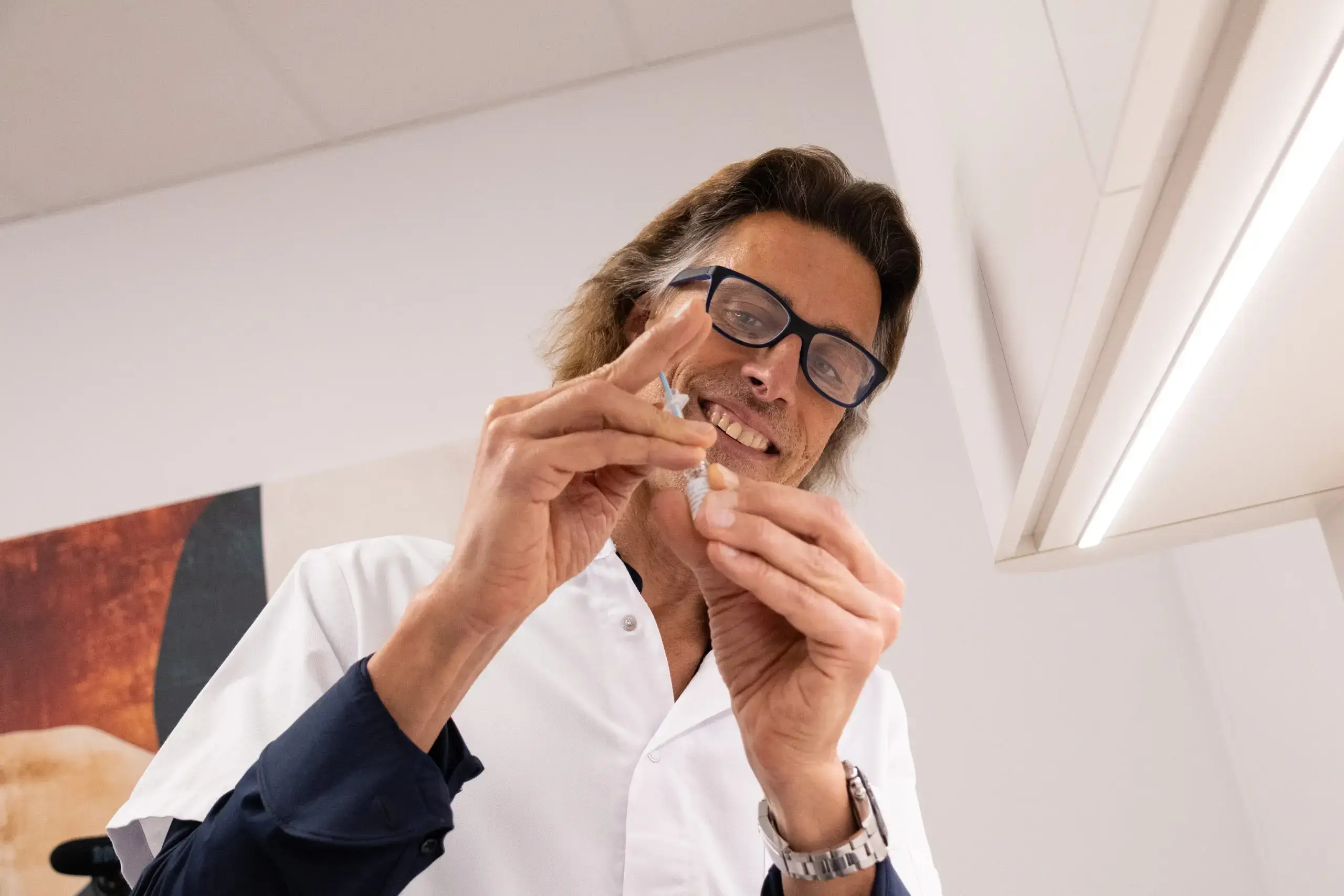
Polynucleotides are fragments of purified DNA material that are injected into the scalp. They do not work as a filler that provides volume, but as a biostimulator: they help the skin to recover better and can support blood flow and the local environment around your hair follicles.
The idea is that a healthier, better-perfused scalp provides a more favorable environment for your hair follicles. Polynucleotides do not create new hair out of nowhere in places where the follicle has already completely disappeared. They focus on strengthening and activating what is still present.
That is why at Dr T. we always first examine the condition of your scalp and your hair before making any promises. This way you know beforehand whether polynucleotides make realistic sense in your case, or whether a different direction is more honest.
This treatment may be appropriate if you are in an early or moderate stage of hair thinning, where the follicles are still active but the hair is becoming thinner, weaker, or less dense. Also for a sensitive or tired scalp, the regenerative effect can be interesting.
Polynucleotides are less or not useful when there is advanced, complete baldness in an area, because the follicles there usually can no longer be activated. In that case, we say so honestly and discuss which other options are realistic, even if they fall outside our range.
We never treat during pregnancy or breastfeeding. The treatment is generally not suitable with an active infection or skin condition on the scalp, or with known hypersensitivity to the products used. During a consultation, we go over your medical history so we can decide safely.
Everything starts with a consultation. We examine your scalp and hair closely, listen to what bothers you, and check how long the thinning has been ongoing. Based on that, we propose an honest plan, or explain why polynucleotides are less indicated for you.
During the treatment itself, we inject the polynucleotides with fine punctures distributed across the scalp, in the zones we have outlined together. We work calmly and carefully, with attention to comfort. The pricks feel uncomfortable but are generally tolerable, and the session is usually completed smoothly.
Afterwards, you can usually resume your day quickly. We give you clear aftercare guidelines and schedule, if appropriate, a follow-up session. Polynucleotides for hair growth often work best as a course of several sessions rather than a single one.
Important to know: this is a gradual process, not an immediate transformation. The action is regenerative, so you give your scalp time to respond. Any effect builds up over weeks and often only becomes noticeable after several sessions.
Many people mainly seek a scalp that looks healthier and hair that feels stronger. The result remains in line with our style: subtle and respectful, aimed at supporting what is there, not on excessive promises of complete hair regrowth.
Because every hair and every scalp responds differently, we cannot guarantee a fixed outcome. What we do is think along realistically with you and honestly evaluate during the process whether the treatment offers enough added value for you to continue.
Right after the pricks, you can expect temporary redness, a sensitive scalp, slight swelling, or small injection marks. This is usually short-lived and disappears spontaneously. We explain beforehand what is normal and when it is better to contact us.
As with any injection treatment, there is a small risk of a bruise or, rarely, local irritation or infection. By working sterilely and carefully, we keep these risks as small as possible. We discuss them with you beforehand, so you can choose with peace of mind.
We also honestly state the limits: if polynucleotides are likely to have little effect for you, we do not recommend them just to do something. Safety and honest advice weigh more heavily with us than an extra treatment.
The price of a treatment with polynucleotides for hair growth depends on several factors, such as the number of zones we treat, the amount of product, and the number of sessions that makes sense in your case. That is why we do not work with a misleading fixed amount.
During the consultation, you receive an honest estimate that fits your situation, without surprises afterwards. This way, you know beforehand what to expect and can calmly decide whether you want to start the journey.
Would you like to know if polynucleotides are suitable for your hair and scalp? Then feel free to schedule a consultation at Dr T. We examine it together, give you a realistic picture, and only choose a treatment if it truly adds value for you.

At Dr. Thierry De Smedt's practice, we combine regenerative medicine with an eye for your natural appearance.
The condition of your hair and scalp determines the exact approach, always matched to what you need.
Polynucleotides stimulate cell renewal and blood circulation in the scalp for stronger, fuller hair.
The active substances support your body's own repair mechanisms without foreign substances or aggressive procedures.
The injections are minimally invasive and are carried out with the utmost care for your comfort.
Plan your personal consultation and discover how we can strengthen your hair in a natural way.
 Best tear trough filler: subtly softening hollow, tired eyes
 Biostimulator
 Biostimulators at Dr T.: firmer skin with a natural look
 Biostimulating filler Radiesse
 Complications with Fillers: What You Need to Know, How to Recognize Them, and What to Do Immediately
 The best fillers for your face: how to choose with confidence