
Do you notice your hair getting thinner, your parting looking wider, or your scalp showing through more? Then you’re probably looking for a gentle, science-based approach instead of empty promises. A polynucleotide hair treatment is an injection course that nourishes the scalp and aims to improve the environment for your hair, in a natural and respectful way. On this page, you can read calmly what polynucleotides do for your hair, who it’s suitable for and when it’s not, how a treatment with Dr T. works, and what you can realistically expect. Honest advice and safety come first, so you can make a choice that truly suits you.
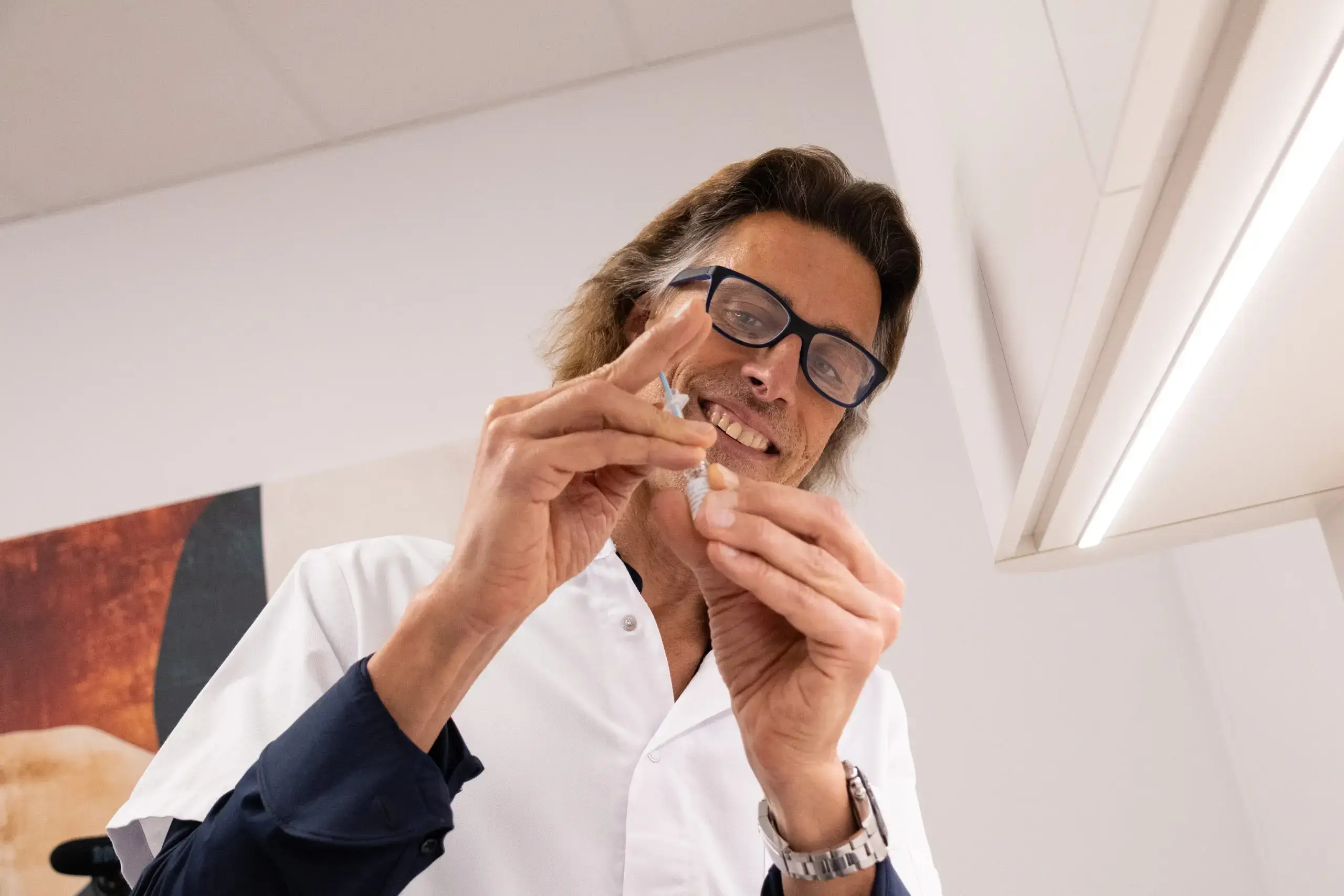
Polynucleotides are fragments of purified DNA building blocks processed into a gel and introduced into the scalp with tiny pricks. They don’t work as a growth agent that magically produces hair, but rather as a kind of nourishment for the tissue around your hair follicles. The goal is to improve the condition of the scalp.
The idea behind it is that a well-hydrated, better-circulated scalp forms a more favourable environment for the hair follicles that are still present. Polynucleotides attract moisture, support tissue repair, and can calm the scalp. In this way, you try to strengthen the foundation in which your hair grows.
It’s important to be honest: this is not a miracle cure and not a replacement for a hair transplant. It focuses on supporting and preserving the hair you have, and on improving the scalp, not on bringing back follicles that have already completely disappeared.
The treatment is particularly interesting if you’re at an early or initial stage of hair thinning: a wider parting, finer hair, or a scalp that is showing through more, while there are still active follicles present. It can also be a gentle support after childbirth or for a generally weakened scalp. Both men and women can benefit.
It’s less suitable when the hair has already completely and permanently disappeared in an area, because there’s little left to support. We never treat during pregnancy or breastfeeding. With an active infection or skin condition on the scalp, or with certain clotting or autoimmune disorders, we also don’t treat, or only after consultation. If another cause (such as a thyroid or iron issue) is involved, we’ll address that part first.
During your consultation, we’ll honestly assess whether polynucleotides make sense in your situation. If we think you’d benefit more from a different approach or a referral, we’ll just say so.
Everything starts with a calm consultation. We look at your scalp and hair, discuss since when you’ve noticed changes, your health, and any other possible causes. Based on that, we propose a realistic plan, usually a course of several sessions spread over a few weeks, because the effect builds up gradually.
The treatment itself is done with very fine needles, distributing the polynucleotides evenly over the scalp in the areas that need attention. A session typically doesn’t take long. Most people experience brief pricks; we work carefully and keep your comfort in mind.
After the session, you can usually resume your day. We give you clear aftercare instructions, such as leaving your scalp alone for a while, not doing intense exercise or going to the sauna right away, and being careful when washing in the first hours. For a course, we schedule the next appointments right away.
A polynucleotide hair treatment requires patience. You won’t see a difference the next day; it works at the level of the scalp and the hair cycle, which can’t be forced. Many people only notice after a few weeks to months and after several sessions that the scalp feels healthier and the hair looks somewhat stronger or fuller.
Realistically, it’s more often about preservation and support than a spectacular increase. The goal is to slow down the loss and improve the condition, so that the hair you have looks better. Results vary from person to person and strongly depend on the cause and stage.
Moreover, the effect is not permanent without maintenance. To maintain the result, periodic maintenance sessions are usually needed. We discuss this honestly beforehand, so you know what you’re getting into and your expectations are aligned.
Polynucleotides are known to be well tolerated, but any injection into the scalp carries small risks. Common mild reactions include slight redness, tenderness, small bumps, or sometimes a bruise at the injection sites. These usually disappear on their own within a few days.
More rare are an infection, longer-lasting irritation, or a hypersensitivity reaction. That’s why a clean medical environment and a thorough intake are so important. We go over your health and medications, so we know if the treatment is safe for you at that moment.
Safety and honest advice weigh more heavily at Dr T. than a quick yes. If you notice anything unusual after the treatment, you can always contact us. We clearly explain beforehand what to watch for and when it’s best to check back.
We can only give a fair price once we know your situation. The cost depends on the areas we treat, the number of sessions in your course, and your personalized plan. A maintenance program looks different from an initial starter course.
During the consultation, you’ll receive a transparent, honest estimate tailored to you, with no surprises afterwards. We explain what a realistic course entails for you and what you can reasonably expect, so you can decide calmly.
Are you unsure whether polynucleotides are right for your hair? Then feel free to book a consultation. We’ll look at it together, without pressure, and give you an honest answer, even if that answer is that another approach suits you better.

Experience a medical approach where your hair’s health is the priority.
Dr T. applies his surgical background to every injection, ensuring safety and accuracy.
Each treatment is tailored to your hair’s condition and your goals, never a one-size-fits-all.
Polynucleotides work in harmony with your body to improve hair density and shine without an artificial look.
We use micro-needling or fine needle techniques to minimize discomfort.
Schedule a consultation to discover how polynucleotide therapy can fit into your life.
 Best tear trough filler: subtly softening hollow, tired eyes
 Biostimulator
 Biostimulators at Dr T.: firmer skin with a natural look
 Biostimulating filler Radiesse
 Complications with Fillers: What You Need to Know, How to Recognize Them, and What to Do Immediately
 The best fillers for your face: how to choose with confidence