
Does your skin feel dull, dry or thinner than before? With a polynucleotide injection, we literally give your skin the building blocks to repair itself. It's not a filler that adds volume, but a biostimulator that improves your own skin quality: more suppleness, more hydration and a calm, natural glow. On this page you'll read exactly what polynucleotides do, who the treatment is suitable for and when it's better not, how it's performed at Dr T. and what you can realistically expect in terms of results and timing. Honest advice and a natural, respectful result always come first.
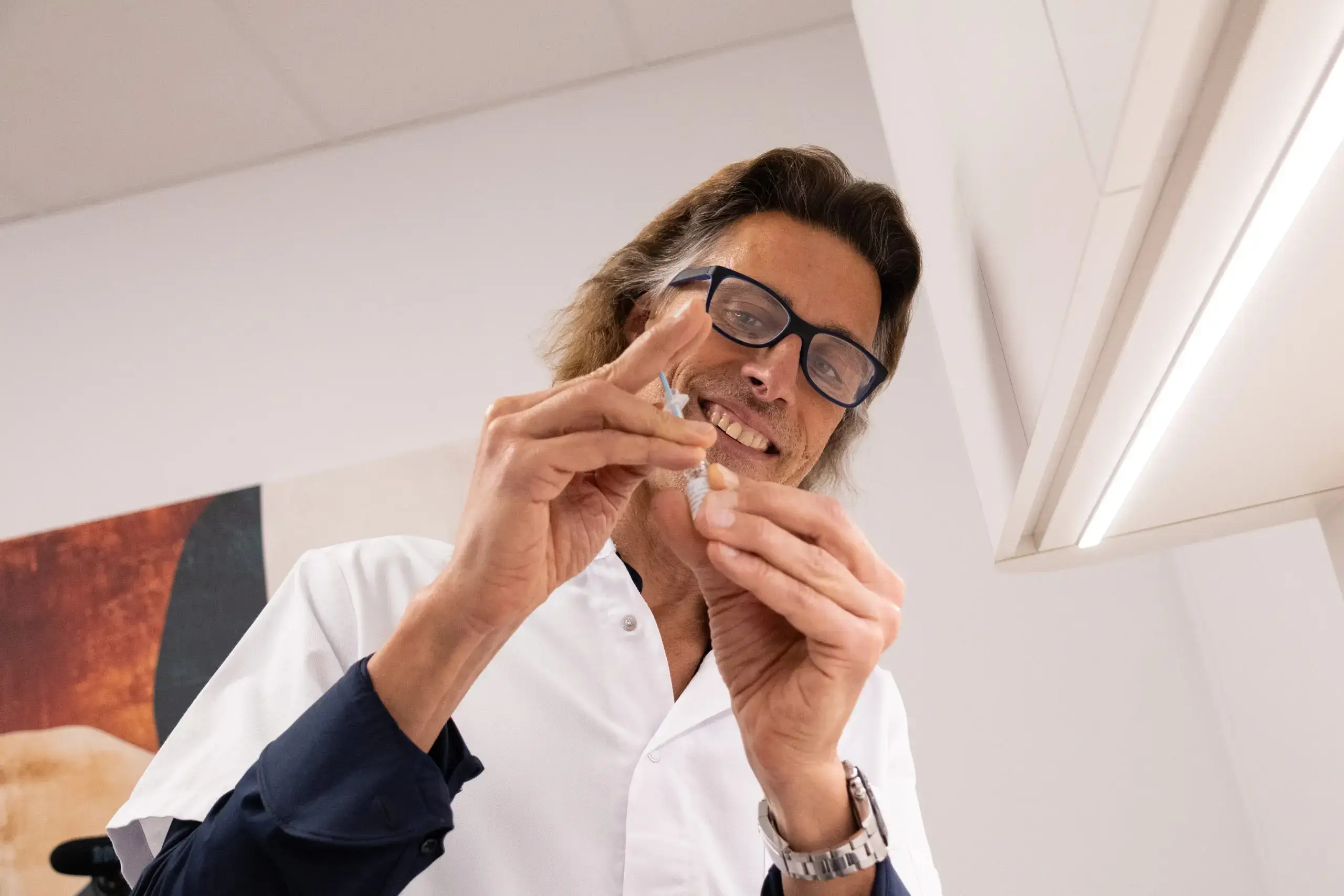
Polynucleotides are long chains of building blocks naturally found in body cells. Injected into the skin, they act as a biostimulator: they stimulate your own skin cells to become more active, help the skin retain moisture better, and support the natural repair process. The goal is not to add volume, but to improve your skin quality.
This is the key difference from a classic filler. A filler fills a wrinkle or adds contour, polynucleotides do nothing to change your facial shape. They make your skin firmer, more supple, and better hydrated from the inside out. Many people describe the result as skin that simply looks healthier and more rested, without anyone being able to pinpoint what exactly changed.
Because polynucleotides primarily target skin quality, they are often used on areas where the skin is thin, dry, or tired, such as the cheeks, neck, décolleté, hands, or the delicate skin around the eyes.
This treatment is a good fit for you if your skin has lost some quality: dull or dry skin, fine lines due to dehydration, thinner or laxer skin, or a tired eye area where you don't want to add volume. Even as a preventive maintenance treatment for your skin health, polynucleotides can be beneficial.
At the same time, we're honest: not every problem can be solved with this. If you mainly have volume loss, deep folds, or a sagging facial contour, a filler or another biostimulator is often a more logical choice. Polynucleotides improve the skin itself; they don't lift or fill. Sometimes a combination is the best approach, and we'll discuss that openly with you.
We never treat during pregnancy or breastfeeding. The treatment is usually not recommended with an active skin infection or inflammation in the area, with certain autoimmune conditions, or a known allergy to the ingredients. During your consultation, we'll go over your health and medications, so we can decide together whether this is a safe and sensible choice for you.
Everything starts with an honest consultation. Dr T. assesses your skin, listens to what bothers you, and checks whether polynucleotides are really the right answer or if something else suits you better. Only when you've jointly come up with a plan do we proceed.
The treatment itself consists of a series of small, superficial injections in the area we're treating. Using a fine needle, the product is evenly distributed in the skin. A session typically doesn't take long. Most people find the pricks quite tolerable.
Polynucleotides work best in a short course. We often schedule a few sessions a few weeks apart, so the skin can build up gradually. After that, a maintenance session follows to preserve the result. How many sessions you exactly need depends on your skin and your goal, and we'll agree on that clearly beforehand.
Polynucleotides don't give an immediate, dramatic effect, and that's exactly the intention. Because they stimulate your own skin, the result builds up gradually. In the weeks after the sessions, many people notice that their skin feels better hydrated, looks more supple, and has a calmer, healthier appearance.
The best result is usually seen only after the full course, when the successive sessions have done their work. The improvement is mainly in skin quality and glow, not in a changed facial shape. The effect is temporary: over time, the skin is no longer actively stimulated, so maintenance is needed to keep the result.
We'd rather promise too little than too much. During your consultation, you'll get a realistic assessment of what polynucleotides can do for your skin, so you know what to expect before you start.
A polynucleotide injection is generally well tolerated. The most common reactions are mild and temporary: redness, mild swelling, small bumps at the injection sites, or an occasional bruise. This usually resolves within a few days.
As with any injection, there is a small chance of infection or a hypersensitivity reaction. That's why we work sterile, with attention to the right technique and area. If you take blood thinners or bruise easily, it's best to let us know beforehand, so we can take that into account.
After the treatment, you'll receive clear aftercare instructions, such as leaving the area alone for a while, not immediately exercising or using tanning beds, and not massaging the skin vigorously. If you have a question afterwards or are unsure about a reaction, you can always contact us.
The price of a polynucleotide treatment depends on several factors: which area you have treated, how much product is needed, and how many sessions your course includes. Because polynucleotides work best in a series, we look not just at one session but at the complete plan.
That's why we prefer not to mention a price upfront that might not be accurate for your situation. During the consultation, we'll assess what you need and give you an honest, transparent estimate of the cost, so you can decide without surprises.
Are you unsure whether polynucleotides are the right choice for your skin? Feel free to schedule a consultation with Dr T. in Ghent. We'll examine your skin, give you honest advice, and together choose the approach that truly suits you.

Polynucleotides are long molecules made up of nucleotides that occur naturally in every cell of your body. When we inject them into the skin, they act as signaling molecules that trigger fibroblasts to produce more collagen and elastin. This process, biostimulation, occurs gradually. Unlike a filler that immediately adds volume, polynucleotides work from the inside out. Your skin becomes firmer, more elastic, and the skin texture improves. The result is a natural rejuvenation without suddenly looking 'injected'.
How do polynucleotides differ from other biostimulators? Sculptra (poly-L-lactic acid) also stimulates collagen but often works over multiple sessions and can cause temporary swelling. Radiesse (calcium hydroxylapatite) provides immediate volume and stimulates collagen, but is less suitable for fine skin quality. PRP uses your own growth factors, but the effect is more variable. Polynucleotides distinguish themselves by their strong hydrating ability and the extra boost for the skin barrier. We often use polynucleotides for dull, tired skin with texture problems, while Sculptra or Radiesse rather offer volume restoration on the jawline or temples. At Dr T., we look together at which combination best approaches your desired natural result.
The ideal candidate notices that the skin is becoming thinner, fine lines are becoming deeper, and the glow is disappearing. Also for early skin sagging on the cheeks, around the eyes or the neck, polynucleotides are an excellent option. Smokers or people with untreated skin conditions are advised against the treatment, and we never treat during pregnancy or breastfeeding. During an extensive consultation, we discuss your medical history and skin analysis. Honesty is paramount: sometimes a different approach or a combination with a filler is more appropriate for the most natural result.
Polynucleotides do not work immediately. The first two to four weeks after the injection, the collagen building process starts. After six to twelve weeks, you see the skin visibly fuller, tighter, and healthier looking. The result often improves even in the months after. We usually recommend a course of two to three sessions with an interval of four to six weeks. Subsequently, an annual maintenance session is sufficient. The longevity depends on your age, lifestyle and skin aging, but expect nine to eighteen months. Compared to Sculptra, the maintenance frequencies are similar, but the focus with polynucleotides is more on skin quality than on volume.
We understand you might be anxious about needles in the face. That's why we use an ultra-fine needle and ensure a gentle technique. During the injection, you often feel only a light pricking; the polynucleotide solution itself rarely causes a burning sensation. Patients describe the comfort as comparable to pinpricks, and we ensure you stay relaxed. After the treatment, there is minimal redness that fades within hours. You can resume your day immediately, although we advise against exercising or sunbathing on the same day.
After the injection, you see small dots on the skin that disappear quickly. Sometimes slight swelling occurs around the eyes or on the cheeks, but that is temporary. Avoid makeup, sauna, and intense heat for the first 24 hours. We recommend continuing to moisturize the skin and using a minimum SPF 30. Results build up, so give it time. In rare cases, a bruise may form, but it heals spontaneously. We follow up with you: a check-up after six to eight weeks helps to assess the effect and, if necessary, plan a next session.
Polynucleotides are excellent to combine with other treatments, provided they are well-timed. If you want to add volume, such as deep tear troughs or cheekbones, we often combine a session of polynucleotides with a hyaluronic acid filler. Botox can be done in the same session, as it works on different skin layers. However, we avoid strong laser or peeling treatments at the same time. At Dr T., we create a customized treatment plan: we look at your skin condition, degree of aging, and wishes. In this way, we maximize the natural result without anyone noticing. Your appearance remains subtly improved.
The price of a polynucleotide course varies depending on the number of vials and the area. Expect a starting course of two to three sessions, with a cost per session ranging from 250 to 450 euros, depending on the amount used. Compared to Sculptra, the session prices are often slightly lower, but Sculptra sometimes provides longer-lasting volume. During the consultation, you will receive an exact price quote. We only work with medically registered products and transparent rates. Investing in skin quality pays off: the improved glow and firmness are lasting with the right maintenance treatments.
 Best tear trough filler: subtly softening hollow, tired eyes
 Biostimulator
 Biostimulators at Dr T.: firmer skin with a natural look
 Biostimulating filler Radiesse
 Complications with Fillers: What You Need to Know, How to Recognize Them, and What to Do Immediately
 The best fillers for your face: how to choose with confidence