
Do you notice the horizontal lines on your forehead deepening, even when your face is at rest? These wrinkles are caused by the repeated movement of your forehead muscle, and over the years they become permanently etched. A gentle treatment can soften those lines without you losing your expression. On this page, you’ll read how forehead wrinkles actually form, what Botox can and cannot do, for whom it’s suitable, and how a treatment with Dr T. proceeds. Honest, medically grounded, and always aiming for a natural result that suits you.
The horizontal lines on your forehead are dynamic wrinkles. They form because you tense your forehead muscle, the musculus frontalis, thousands of times a day: when surprised, raising your eyebrows, or simply out of habit. Each time the muscle contracts, the skin above it folds along.
As long as you’re young, the skin bounces back smooth afterwards. Over the years, elasticity decreases, collagen diminishes, and the skin recovers less well. The folds that were first only visible during movement then remain at rest as well. This is how dynamic lines gradually turn into permanent, static wrinkles.
That’s why a treatment works best when you address the moving cause: less repeated tension means the skin gets a chance to lie quieter and fold less deeply.
Botox relaxes the forehead muscle in a targeted, dosed way. The muscle moves less forcefully, so the skin above no longer creases as deeply into the same fold. Existing lines gradually fade and new, deeper wrinkles have less chance to form.
It’s important to be honest: Botox mainly softens dynamic wrinkles. Deep lines that have been at rest for a long time become softer and less noticeable, but often don’t disappear completely in one go. The goal is not a tight, smooth surface, but a calmer forehead that still suits you.
At Dr T., the forehead is never treated in isolation. The forehead muscle and the muscles that pull the eyebrows down work together, so the dosage is carefully balanced to keep your eyebrows at a natural height and maintain an open look.
A forehead wrinkle treatment is suitable if horizontal lines bother you, especially when they make your face look tired or worried when you’re not. It fits well with people who want a subtle, natural result and want to keep their expression.
Sometimes Botox in the forehead is not the best or not the first choice. With a low-set or heavy eyebrow, relaxing the forehead muscle can actually weigh down the look, because that muscle helps lift the eyebrow. Then we’ll first look together if a different approach or timing is better.
Botox is never given during pregnancy and breastfeeding, and is also not recommended with certain muscle and nerve disorders, with an active infection or inflammation locally, or with a known allergy to the ingredients. During the consultation, we’ll go over your medical history so that a treatment only proceeds if it’s safe and appropriate for you.
Everything starts with a consultation. Dr T. looks at your forehead at rest and in motion, discusses what bothers you and what you expect, and assesses the connection with your eyebrows and your upper face. Based on that, he proposes a tailored plan, or honestly explains when it’s better to wait.
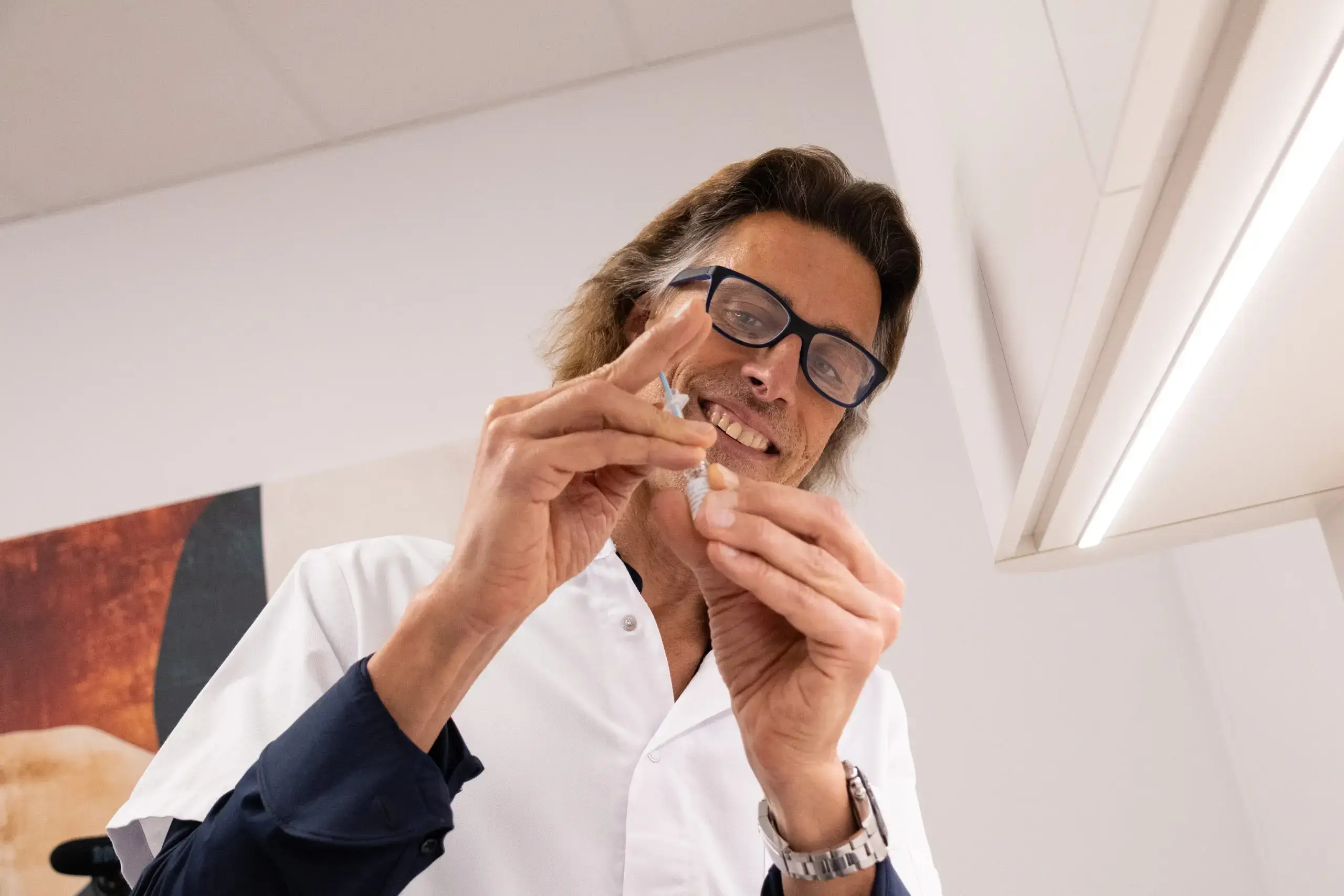
The treatment itself is short. With a fine needle, a few precise, dosed injections are placed into the forehead muscle. Most people find it well tolerated: a brief prick per spot. Afterward, you can usually get on with your day right away.
After the treatment, you’ll receive clear aftercare advice, such as not rubbing the area for the first few hours and postponing strenuous exercise briefly. A short check-up can be scheduled to assess the result together and possibly fine-tune it.
The result doesn’t come immediately, but gradually. Usually you’ll notice the first change after a few hours to 3 days, with the full effect typically visible around two weeks after treatment. Your forehead feels calmer and the lines become softer.
The effect is temporary. Over the course of months, the muscle movement gradually returns and the lines become visible again. Exactly how long it lasts varies from person to person and depends, among other things, on your muscle strength and the chosen dosage. A maintenance treatment can keep the result.
Want to know if a subtle treatment suits your forehead? During a consultation, Dr T. calmly looks at what’s feasible and desirable, and what a natural result means for you.
Botox is a well-studied treatment, but no procedure is entirely without risk. Common, transient reactions are slight redness, a small bump or tenderness at the injection site, or sometimes a mild headache. These usually go away on their own after a few days.
Rarer, and often linked to dosage or technique, are a drooping eyelid or a heavier or asymmetrical eyebrow position. That’s exactly why Dr T. works conservatively and tailored: rather a calm, natural result than too forceful a relaxation. If something doesn’t feel right, you can always come back for follow-up.
The price of a treatment depends on what your forehead needs, the areas we treat, and the amount of product used. There’s no fixed price that fits everyone. During the consultation, you’ll get an honest estimate, so you know what to expect before you decide anything.

Schedule a personal consultation with Dr T.
Make an appointment Cosmetic treatments at Dr T.: choose a natural refresh
 Choosing a cosmetic clinic: natural, subtle and safe with Dr T.
 Looking tired when you're not? How to tackle a tired-looking face
 Aesthetic Clinic in Ghent: How to Choose Safely and Naturally